Projected Images Of Light
(In Performance Art)
I have long held a fascination for the magic of projected image, its strength and diversity as a media, and its application in the visual and performing arts. By the term projected image I refer to the uses of visual light-projection whether through film, video or slide. I wrote this short essay in the 1990s when a musical production of Pete Townsend’s Tommy proved for me a masterpiece of visual projection technique. Designer Wendall Harrington successfully integrated both slide and video with highly imaginative and innovative uses of lighting, and elements of shadow theatre.
Comparable to the development of twentieth century music, art performance seems to have evolved in a series of leaps and jumps. The use of light projection within this diverse history has been varied and inconsistent. Both World Wars caused a divergence of technology away from artistic use although the same technological advances impacted on the camera, opening new areas of creativity for artists who could directly engage with the translation between two and three dimensional space. My first degree was in Music with Visual Art (Brighton) and by close of studies I had become primarily concerned with visual composition within the frame of a slide print. How quickly technology changes. At that time (1997) digital image was still in its infancy. During this period, I was in agreement with David Hockney who stated that television was “not a particularly visual medium,” slide image then being 24 times sharper than the electronic (now digital) image.
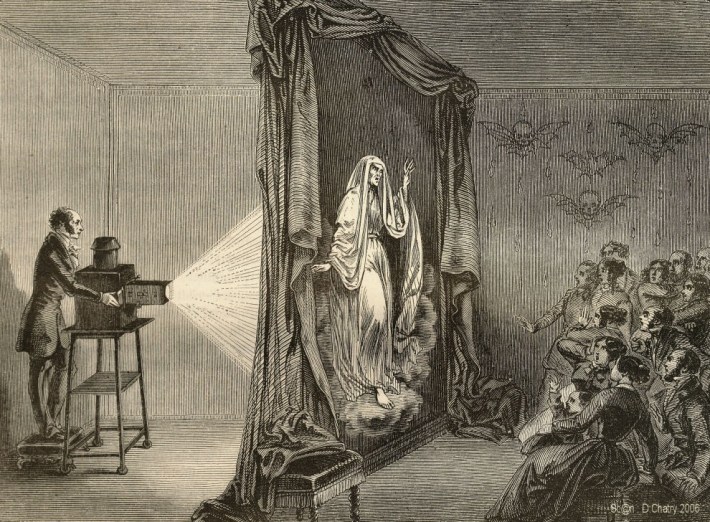
An audio track as synchronised with hand-levered pulses for slide changes was still considered experimental as late as the mid Seventies. Paradoxically, the use of slide projection accompanying sound and music predates both photography and cinema. In 1885 a London optician named Hughes produced a slide containing movable silhouettes a decade before Alexander Black printed photographs onto lantern slides. Black produced a sequence of 250 transparencies noting an effect “unlike that obtained by Mr. Edison…” [1]. An even earlier performer who exploited the possibilities of light projection was Etienne Robertson (above). Born in 1763, Robertson’s early experiments with a solar microscope resulted in a projection of an enlarged human hand. One can only imagine its reception. Robertson produced painted slides of ghosts and monsters for performance. His Paris shows of 1789 accorded a political edge with imagery reflecting the climate of revolution. Robertson’s Phantasmagories used a 24’ x 80’ performance space inside a ruined convent, his audience led in through the remnants of the cloister. The congregation was bombarded with spectacular imagery from the 20’ square back-projection screen accompanied by a variety of mind-blasting sound effects. One of Robertson’s innovations was the Fantascope Lantern set on rails behind the screen, and as it was wheeled back the images loomed threateningly. Courier de Spectacles describes one performance of 1800: “Diogenes, holding his lantern – seems to pass through the audience… a brilliant star shines out of the chaos…” [2]
Shadow theatre is of course closely associated with ancient Eastern art and is the earliest example of projected image with sound. Its associations can be traced back throughout western theatre history. The RSC production of Peter Pan (Barbican Centre, 1984) was notable for its opening sequence. A blue screen depicted the black silhouette of a house which, with changes of light, was revealed as a detailed three dimensional set. The screen was then raised as the construction slid forward, rotating to reveal an interior stage. The impact is the element of surprise via the disruption of dimensional perception. The musical Tommy (Shaftesbury Theatre, 1996) opened with multiple images from a back screen divided into sixteen frames. As these images changed, a front gauze depicted secondary projections. For example, a front projection of war posters overlaid a rear video screen of descending parachutes. Throughout Tommy, performers moved between a back projection and a front gauze as shadows played and flickered to follow the live action. At the opening of the 1996 Atlanta Olympic Games, silhouettes of athletes were projected onto a monolithic canvas temple accompanied by a recording of Martin Luther King.
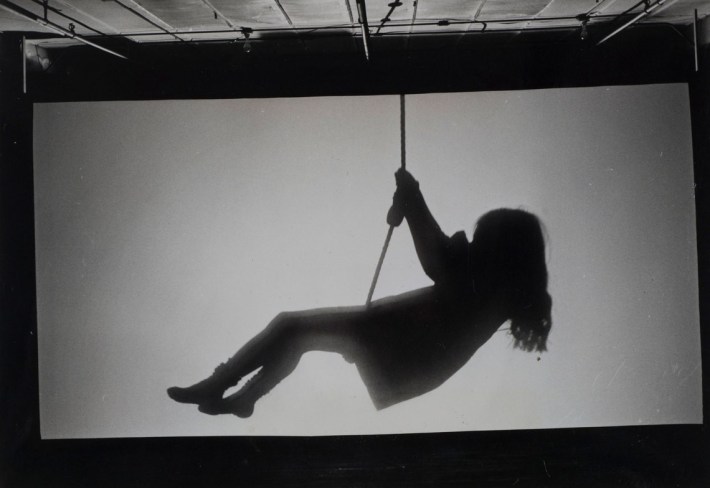
Ken Jacobs explored shadow in Slow is Beauty – Rodin at the Idea Warehouse in New York in 1974 (above). Two light sources caused opposite shadows of performers who took poses from the changing slides. Dorothy Pam noted that the “double shadows… break down the movement… just as Duchamp analyses movement cubistically…” [3] At one point the shadow of a film projector appeared, together with the film image refracted onto the screen using an angled mirror. As Pam explained, “the mind tries to deal with the paradox – which is more real? The detailed illusion of the film or the abstracted shadow of people in space and time?” [4] Entering into this world, confronting spatial boundaries, questioning what is real, is something that Jacobs like Robertson defined as a journey. Jacobs’ audience was led in from street level, shone with strobe lighting, and traversed into the performance space on a balance board. Duplicities of Post-modernism alongside and due to technological advance were further addressed in this piece that interspersed colour slides with stereo-optic images by Victorian photographer Muybridge. (Also in New York, Robert Morris made literal translations of Muybridge slides in his dance piece Waterman Switch a decade earlier.) Goldberg explains how art performance may be interpreted as “a transformation of real and dreamed events…” [5] As art became increasingly accessible via the advancement of mass media, many artists sought to disrupt preconceptions of their discipline.
In 1922 Frederick Kiesler included film in his set design for Capek’s production R.U.R. The movement of machinery was projected onto a circular screen placed within an abstract arrangement of neon lights. Mirrors reflected miniaturised images of performers who then entered the industrial space in real life. Two years later, Rene Clair produced his film Ent’racte to link live acts of Picabia/Satie’s ballet Relache. The final scene depicted a cast member falling from a coffin at which point the troupe broke through the screen to commence the second act. Leger commented how “the author, the dancer, the acrobat, the screen… are integrated and organised to achieve a total effect…” [6] These were just some of the ways in which art performance – or what became known as Performance Art – forged a new language that in turn created innovations in theatre. Similar presentations at Bauhaus acquired an immense level of interest in the late 1920s, and director Oskar Schlemmer founded the school’s own touring company with the defiant proclamation that “I have now pronounced the death sentence for theatre…” [7] Following the Dada and Futurist movements in Europe came fresh emphasis on American performance in the 1930s. The Third Reich terminated Bauhaus and in 1933 its members travelled to Black Mountain College in North Carolina. Here, Schawinsky set out his manifesto for Stage Studies, an exploration of “space, form, colour, light, sound, movement, music…” [8] Post-war, art performance became increasingly representative of technological progress. Composer John Cage reflected this through innovative works mixing electronic and acoustic instruments, often infused with idiosyncratic imagery. In an untitled event at Black Mountain College, Robert Rauscenburg projected slides of coloured gel montage to accompany a monologue by Cage. With choreographer Merce Cunningham, Cage staged an audio-visual piece Variations V (1965) featuring several projection screens placed around the dance space. The dancer activated photo-electric cells wired to the floor which triggered changes of projected image.
The use of the moving image in performance underwent resurgence via video in the 1970s. Particularly in the sense that artists were able to view themselves, and place fresh perspective on the methodologies of their craft. An early example of interactive video is found in Dan Graham’s Two Consciousness Projection (1973) in which a woman poses for a monitor whilst describing her face. At the same time, the cameraman describes the face as he sees it. Goldberg points out that “Graham’s theory of audience-performer relationships was based on Bertold Brecht’s idea of imposing an uncomfortable and self conscious state on the audience in an attempt to reduce the gap between the two…” [9] Throughout the 1970s rock singers including David Bowie produced startling music videos whilst adopting circus-like changes of personae. The use of light projection is seen time and again in pop video. Layering effects such as the projection of moving wheels onto the human body were used in Cyndi Lauper’s video I Drove All Night (above). Swiss duo Yello were photographed beneath a projection of their album cover, and have performed on top of a stack of televisions. The 1981 performance Otello by Italian troupe Falso Momento proved a disarming blend of the old and the new. It merged clips of Hollywood movies alongside live opera, whilst Peter Gordon’s score blended the traditional with the experimental.
In the 1980s, Laurie Anderson’s hit song O Superman from her performance piece United States seemed to bring art performance to the fore of popular culture. Anderson considered that “I like to make a situation in which the images go along like this, the music along like this… to create a kind of poly-rhythmic situation…” [10] United States combined singing with dialogue, and movement and slide projection with live music. Her fascination for language was also expressed visually, as she stated, “words have become… the basis of the images and the sounds…” [11]. Anderson used photographic image projected alongside abstract text as demonstrated in Empty Places (1990) which confronted the interpretation of the printed symbol. Goldstein commented that “much of [Anderson’s] work as a performance artist focuses on how modern society is coping with the onset of high technology – but Laurie Anderson’s live and recorded pieces use it to the full…” [12] Light projection (or film projection as it is more widely known) has since acquired immense commercial appeal, with countless large scale projections onto public buildings for example. In 1989, protesting at the cancellation of Robert Maplethorpe’s exhibition, Rockne Kreks projected slides of the photographer’s work onto the walls of Washington’s Concoran Gallery. As Bill Wooley remarked, “if they can’t be on the inside… they’re going to be on the museum…” [13]
In the 1990s, Nathan Coley employed both video and slide in his piece Lecture (Galleri Index, Stockholm 1996). This parodied the worst of corporate slide shows, displaying images of utilitarian architecture ad nauseam. The seminar was preceded by Coley’s video piece Waiting in which time-wasting situations were projected onto a sofa. In a similar crossover between the imagined and the real (or inhabiting a re-imagined reality) Smith/Stewart brought filmed performance to a new plane. For Sustain (1996) Stewart was filmed submerged in water until Smith revived him with her breath. The set-up was purposely objective although as Melissa Feldman notes, “Stewart’s gasp for breath is all too real…” [14] Meanwhile, Dalziel and Scullion’s The Gifted Child (1996) comprised projected image onto circular sand-blasted glass, of shots from above and beneath water cut with sequences of synchronised swimming. A new palette of translucency and light, together with natural elements, had become a tangible medium. The spiritual aspect of water was again explored in Bill Viola’s piece The Messenger (1996). A male figure rose and sank, dissolving with a ripple amidst shining bubbles that suggested the cosmos. Like taking a mind-bath, the artwork took the viewer through various emotive responses to an altered human image. Viola reminded us that “gradually more people are realising that the twentieth century artist is not necessarily someone who draws well but someone who thinks well…” [16] It is fascinating to consider how ‘the message’ differed between the still image and the moving image. This difference, when translated through press coverage, caused controversy during its installation at Durham Cathedral: any printed frame succeeded as a still, though resulted in a redefinition of its theme.
I was initially attracted to slide image due to the range of media that could be manipulated in a number of different ways. The enlargement of a hand made slide for example afforded a new dimension to the fabric of image making, and took on a fresh perspective when reproduced as a print. Walter Bergomoser’s workshop In the Sense of Light (Terra Nova Project, Glasgow 1996) dealt with “experimental approaches to the medium, both philosophically and technically… the difference between a transparency and a print in terms of light…” [17] My concern was with building layers of texture. The addition of textural layers transformed the line, particularly when transposed through light-projection to intriguing paintings of light.
In the musical theatre production of Tommy, come the central character’s emancipation his yellow figure leapt across the back screen in a series of alternating poses. This highly effective sequence was poignant where a real time video would not have succeeded. Why? Consider how in a radio play listeners are required to forge their own visual connections. In the same way, the simple means by which sequential image fuses the aural with the pictorial relies on the imagination of the viewer. With film the eye reads 24 frames per second but slide-shows allow mental space for the observer to register their personal reaction. Beaumont-Craggs illustrated this with an example from Russian film maker Koulechov (above). Koulechov instructed an actor to clear his face of emotion. The shot was spliced with images of food, sexuality and death. The audience’s response to the symbols became attributed to the actor. Referred to as the Koulechov Effect it is used extensively by movie directors, Hitchcock its most famous exponent.
There seems something about human memory that is snapshot. The idea of freezing moments in time returns to the roots of visual art. Storytelling with image is as ancient as hieroglyphs. Slide-shows connect with human experience, as in the parade of holiday photographs or the supposed flashing images seen before death. As an undergraduate, my exploration of this media suffered due to such connotations. However, audiences at my shows demonstrated genuine surprise at the strength of the finished pieces. The layering of imagery set-up all kinds of relationships, whilst secondary images between dissolves – where two images are overlaid – adopted their own significance (quite apart from being important compositional links). Hence there was often a dream-like quality to slide-shows which as Beaumont-Craggs notes would “move the audience emotionally…” [18]. Dissolves could move through time and form so that the subject matter underwent transmutation. Slide-shows offered alternative views of the actual, the abstract, the spatial and the emotive. Exactly as the brain considers many aspects of one subject or as “viewed” through many facets.
I produced my first slide-show Repossession in 1996 (Performance Platform, Sallis Benney Theatre, Brighton). The idea came from a case study of a steroid abuser from a TV documentary. The effect of steroids seemed to me to mechanise the human body, and I started to use bar-codes as symbols of entering a new state of being. Every consumer item of that era began to have its own bar-code; distinct binary strips read by a flashing laser, the red light transposing information as if the very spark of life. I was photographed beneath projections of bar-codes as well as hand made textures, and the photographic slides were alternated with the primary artworks. These experiments formed the basis for the opening section of a slide installation in three parts, Sensing (The Dance Studio, Brighton School of Art, 1997). Many of these pieces employed rapid changes of imagery. The opening of Sensing consisted entirely of kinetic stripes in fast dissolve that I have since reworked, moving away from the now hackneyed image of the bar-code. A second piece from 1996 was titled Treading Air (The AV Room, Brighton School of Art [above]), for which I concentrated solely on texture. I had discovered that textural slides evoked a sense of landscape in contrast with my previous piece. I made the conscious decision to explore a natural palette that become spatially atmospheric via light-projection. I continued to use a variety of glues, paints and pens for mark-making but chose different grounds including newsprint and tissue – the light varied according to how it was filtered. The same year, I experimented with photographs printed onto acetate and further noted the metamorphosing effect of dissolves from negative to positive, and between colour and monotone.
Slide image continues to be used in performance but as an art form its complexities remain somewhat under explored, and now seem all but obsolete in the digital age. When Brian Eno staged a Three-part Lantern Lecture at Sadler’s Wells in 1992, his ambient images accompanied an uninspired monologue seeming to justify, as Andy Gill noted, how “the slide-lantern lecture is a form that has long since lapsed into disuse…” [19] Other artists were using slide projection in completely new ways. For Terry Mirrors (1996) Terry Atkinson appropriated “a ‘machine’ that attempts to model consciousness…” [20] A VDU was inserted into a large white painting on Styrofoam panels, with a monologue simultaneously broadcast and printed. Tiny mirrors vibrating on motors reflected slide images which scuttled across the white painting. Once again, a selection of historic imagery disrupted the “modernist visual purity” (sic) of a stark white canvas. At that time many CD ROMs were emerging including Laurie Anderson’s wonderfully imaginative Puppet Motel (1995) whilst traditional slide shows faded in popularity and slide carousels ceased manufacture.
Conclusion
Leaving the creative arena that university provided necessitated its own conclusion. I have since worked more extensively with digital image, and using PowerPoint as an animation tool. In the 2010s, I’m learning to convert or reprogramme slide shows to videos of variable quality. Yet it was through a high level of experimentation with so-called traditional media that I truly learned something new. How traditional is slide image anyway, in relation to the far longer history of art? That we wouldn’t forsake the pencil or brush sometimes makes me stop to reflect on this highly creative period of my artistic life. When artists investigate established media in new ways, surprising conclusions are reached. And though I now explore the digital, I am still scanning those hand-made and analogue slides from twenty years ago.
Brighton, 1996 │ Revised London, 2000 and 2014
Further reading: Margaret Nolan Interview

[1] Beaumont-Craggs, R (1975) Slide-tape and Dual Projection p81 Focal Press, London and New York
[2] Ibid. p121
[3] Pam, D (March 1974) The Apparition Theatre of Ken Jacobs The Drama Review T65 p98
[4] Ibid. p101
[5] Goldberg, R (1988) Performance Art p130 Thames and Hudson, London
[6] Ibid. p95
[7] Ibid. p97
[9] Goldberg, R (1988) p162
[10] Anderson, L (August/September 1982) A Real Traditionalist Performance 18 p6
[11] Ibid.
[12] Goldstein, D (February 1985) Making Music with Big Science E&MM p48 (NB Reference from untitled file at St. Peter’s House, Brighton University Library)
[13] Steiner, W (1995) The Scandal of Pleasure p20 University of Chicago Press, Chicago and London
[14] Feldman, M (May 1996) Love Hurts Art Monthly p25
[15] Visual Arts UK Durham (September-November 1996) Brochure for Durham City Arts
[16] O’Hagan, A (September 1996) Diary The Guardian The Week p6. N.B. Undated personal file.
[17] Street Level Photoworks (1996) In the Sense of Light Flyer for Gallery Education Workshops, Glasgow
[18] Beaumont-Craggs, R (1975) p84
[19] Gill, A (23 July 1992) Searching High and Low The Independent (NB No page reference on file. St. Peter’s House, Brighton University.)
[20] University of Brighton (1996) Circumstantial Evidence Introduction to University Gallery Exhibition
 Martin Slidel